
The History of Psychological Projection
Not everything is pathology

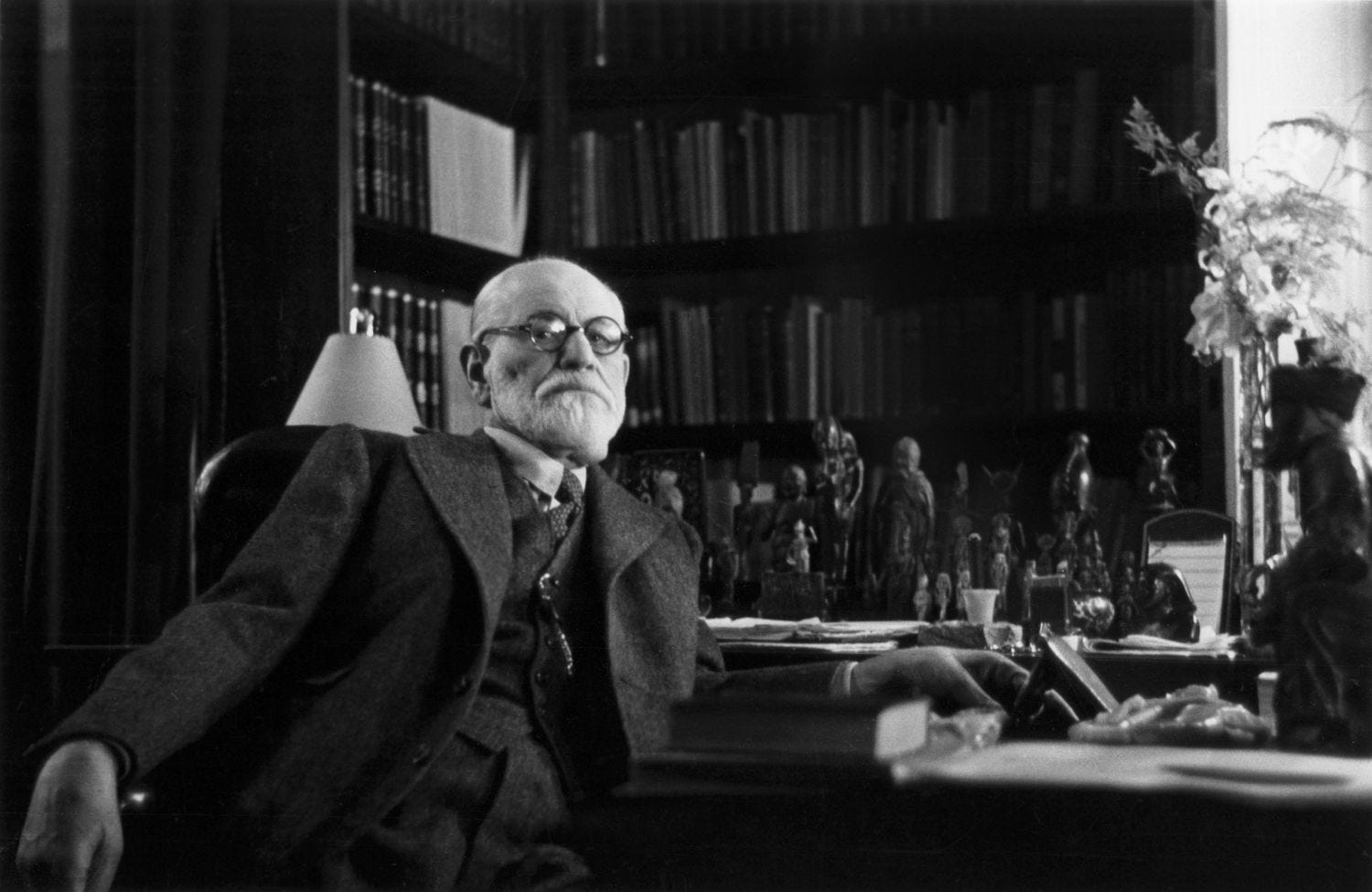
Freud was wrong about projection.
Most people think of it as a way to escape:
a bad conversation
an uncomfortable emotion
a shitty relationship dynamic
The first time I understood projection, I felt the same. I was sitting in a group under fluorescent lights at the Toronto Psychoanalytic Society & Institute wrestling with seemingly esoteric psychodynamic theory.
The theory, as we were reminded again and again, was of disturbing thoughts that violate some sense of self. We defend ourselves by displacing these thoughts into another:
I am not racist, they are.
I am not jealous, they are.
I don’t want to kill, they do.
The idea is that you don’t own your own darkness, so you don’t have to deal with the discomfort of having blood on your hands. You perceive the blood to be on the hands of another.
This is how I understood projection, until now.
The History of Projection

Freud initially saw projection as something pathological.
He thought of it as a defence mechanism. A means of escaping internal conflicts. What’s more, Freud thought it was isolated to the therapeutic dyad. Projection only occurred inside the four walls of the clinic, between the analyst and analysand
Sándor Ferenczi was an analyst who was greatly influenced by Freud.
Ferenczi expands on Freud’s ideas and brings other people into the room. Ferenczi correctly saw projection as a normal part of life. To be human is to constantly push internal emotions outwards and take external qualities in.
Ferenczi pioneered the concept of introjection.
We do not become who we are without being shaped by the world in some way. When you introject something, you take in part of the external world and identify it as your own. We take in rules and regulations, morals and beliefs, and other social mores. We identify with them. They become a part of our modus operandi.
Ferenczi set the ground for a more relational view of human behaviour. You are not just an island unto yourself, defending against dangerous drives. You are inextricably connected with and moulded by the environment.
From Internal Drives to External Relationships
Where Freud saw drives as the foundational material of the mind, Melanie Klein saw relationships. Ferenczi analysed Klein in Vienna, so he no doubt influenced her thinking.
Klein built on Freud and Ferenczi’s ideas when she introduced the concept of projective identification. Some people consider projective identification a combination of Freud’s projection and Ferenzi’s introjection.
When you identify with a projection, you experience feelings that another person projects into you as if they belong to you. Imagine visiting a loved one to find them filled with anger because of their boss's incompetence. When you ask them what the matter is, they ask you to stop raising your voice even though you were speaking in a normal tone. You now feel angry and loudly say, "I wasn't raising my voice!".
A common thread among Freud, Ferenczi, and Klein is that the projective mechanism is pathological. Cognitive psychologists have found a far less threatening way to interpret projections compared to psychoanalysts.
Contemporary Views
Cognitive psychology sees the projective mechanism as a universally unavoidable perceptual and cognitive bias that develops through interactions between your biologically-mediated temperament (nature) and personal experiences (nurture).
Rather than a process of disavowing your true feelings, projection is a mechanism through which you experience the world. We are all shaped to experience the world in fundamentally different ways based on our nature and nurture.
Take the Rorschach test for example:
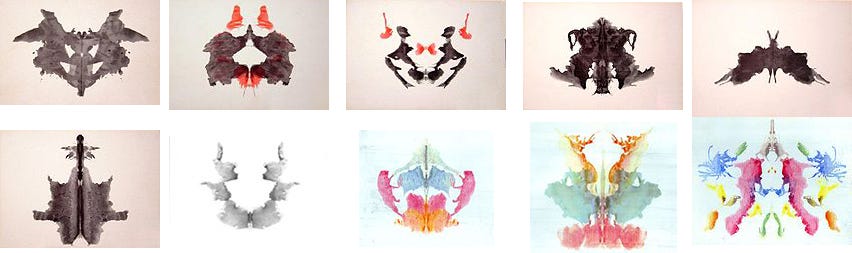
We see ambiguous inkblot images that are not meant to impose meaning. The themes that emerge from viewing a collection of these images are thought to unveil underlying emotional or cognitive patterns. This gets at the projective mechanism itself.
Another example of this comes from the Heider-Simmel Animation:
On the surface, it is a video showing simple geometric shapes moving around. What you attribute to the moving geometric shapes comes from the observer's perceptual framework (or projective mechanism).
I’ll never forget what a peer of mine said while watching this. She was adamant the animation depicted a child’s (circle) angry father (big triangle) shouting at their mother (small triangle). Her parents were divorced. I felt for her.
Through this lens, projection is not just a way of defending against negative emotion.
Rather, it is a foundational perceptual process that is shaped by your biology and personal experiences. It acts as a tool for reaching out to and comprehending the world from the perspective of your own lived experience. This view fosters connection and understanding rather than creating an air of suspicion about ourselves and others.
So, was Freud wrong about projection?
Before you go: If you enjoyed, please share it with one person you think would benefit:
I would not necessarily deem the Freudian conception of projection as incorrect; rather, I find it to be incomplete.
Projection, as I understand it, represents a dialectical ascendancy.
In this process, an individual imprints their subjective framework onto the world. This act resonates with the world’s determined, pattern-like nature, thereby establishing a correspondence with the subjective framework. From this correspondence, the subjective perception then integrates with the phenomenological discourse, leading to a complex interplay of ideas, experiences, and understanding. This process, thus, can be considered as a participatory being, where both the perceiver and the perceived actively contribute to the ongoing formation of subjective reality.